Last night we were under power for only three hours; consequently, we slept well. The morning was clear with a stronger breeze. There are times when I can feel connected to the history of the islands. I think of Charles Darwin and other sailors discovering these islands. Wondering at the easy meals provided by the giant tortoises and slow moving iguanas. The temperatures year-round average around 70 degrees with little variation. The islands were first discovered in 1535 by the Bishop of Panama, who was blown off course on his way to Peru. Darwin spent time here in the 1830’s. The conquering Spanish ignored the islands as did just about everyone else, since there was no loot or easily accessible fresh water. In the age of the sea pirates, this was a good home for English pirates who preyed on Spanish ships bound to and from Peru.
It was mostly the British that explored the islands; it was probably also the British who introduced goats and black and brown rats, each of which is destructive of the native fauna. Most of the islands are semi-desert, They are volcanic islands, the same as the Hawaiian Islands. In 2004, park officials decided on a drastic solution regarding the feral goats who were destroying native flora on Isabela Island. Using high tech trackers and helicopters, sharp shooters killed over 150,000 goats. This brought outrage and concern around the world, but today there are very few goats remaining.
The islands remained mostly uninhabited until late in the 19th century. The population is very modest at 35,000. The bustling little town we visited last night contains 3,000 souls. Almost all of the islands are protected (97%), by the Galapogos National Park. The marine environment is protected by the Galapogos Marine Reserve.
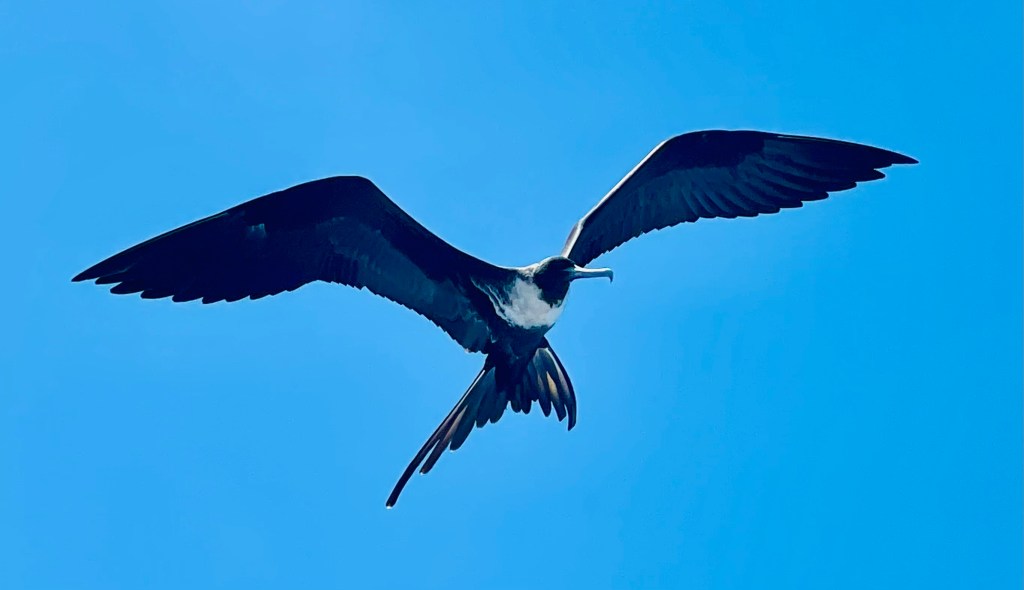
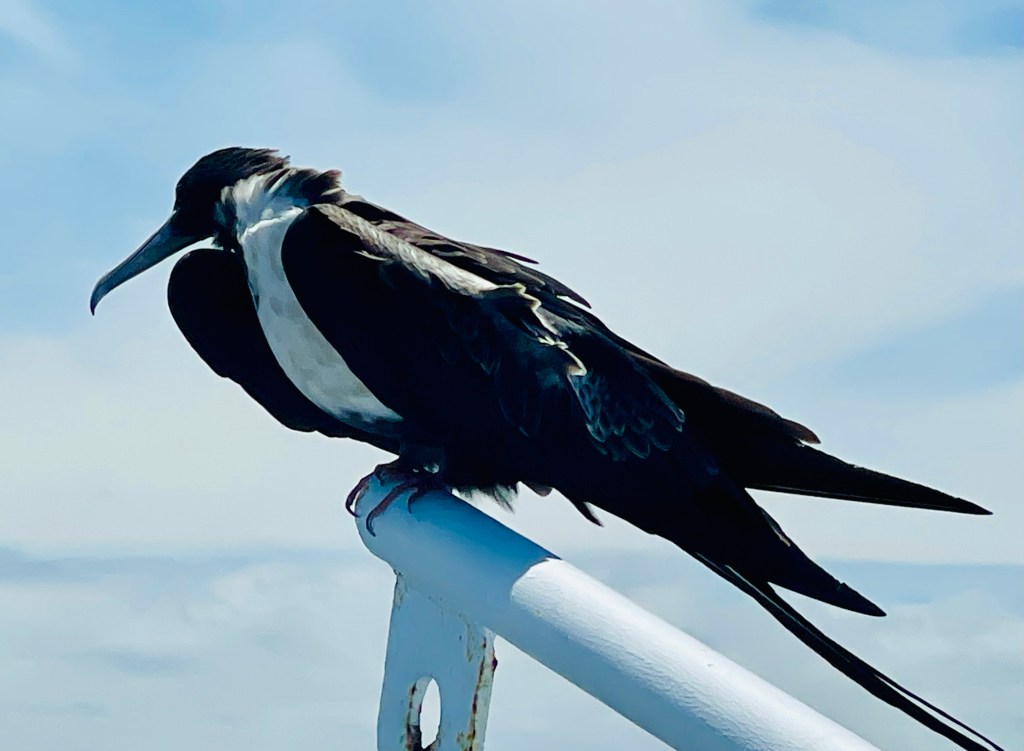
Frigate birds frequently soared overhead. As I understand it, these graceful and agile flyers are mostly pirates, stealing prey from other birds rather than hunting themselves.
Sitting, they can look fearsome.
This morning started with a panga ride to see iguanas, blue footed boobies, sea lions and rays. Isabela Island can be magical, the wonder of the local fauna is amazing, adding the weight of history makes it feel awesome. There are no seals here, only sea lions. There are no hummingbirds as it is too far for them to fly. We are 600 miles off the coast of Peru, but we are still on the equator. In fact, I understand that we will cross the equator on this voyage and return momentarily to the northern hemisphere.
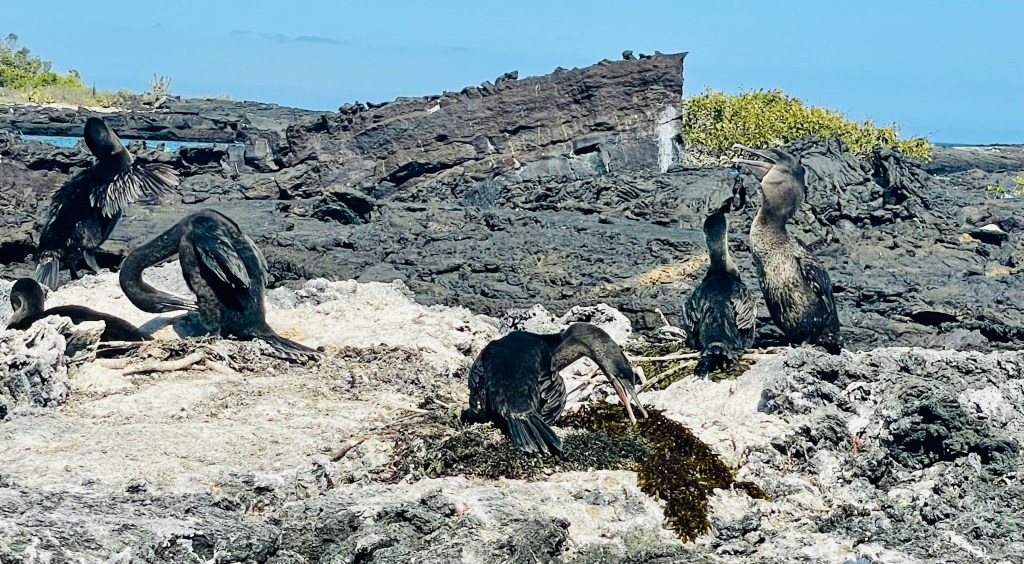
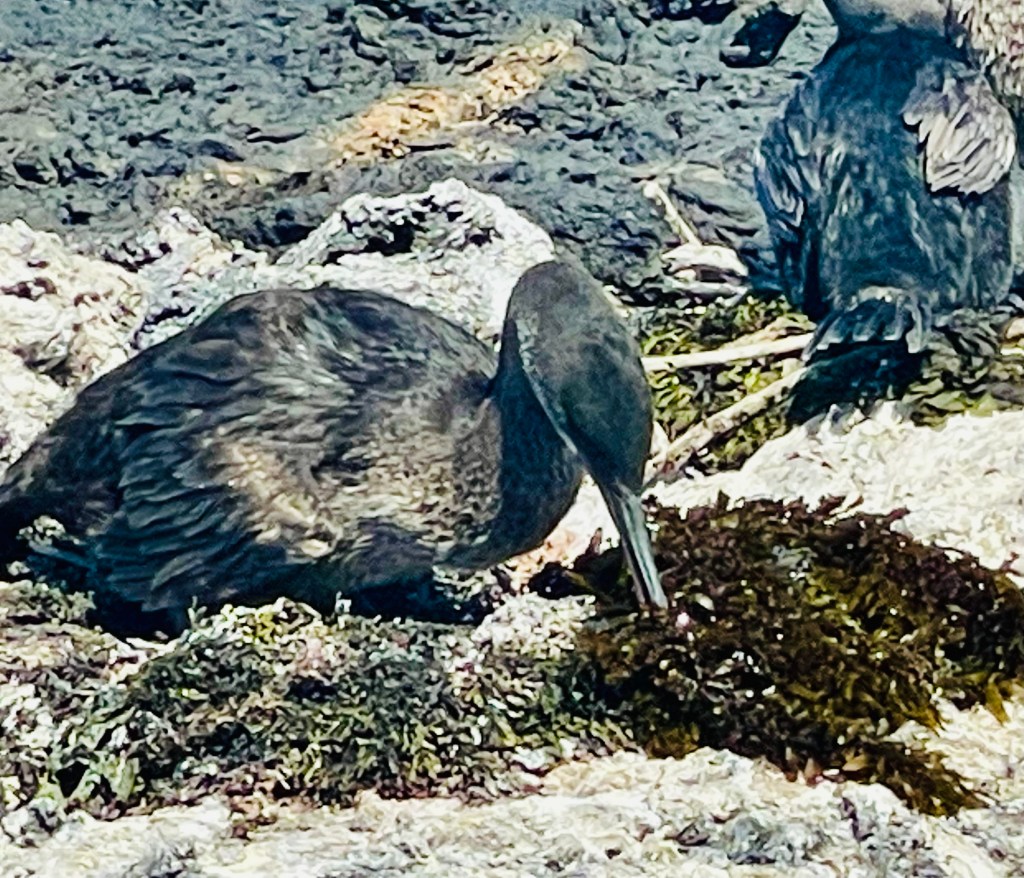
The flightless cormorants are endangered and largely live on Isabela Island. They can dive 60 meters deep. That’s meters! Or over 180 feet down. This is a colony of cormorants. Food was so plentiful here that they no longer had a need to fly, so the theory goes, and they lost their ability to fly at all. The seaweed in the foreground is nesting material. The male and female birds take turns sitting on the eggs or hunting for food.
On our panga ride, we were all shifting around to take pictures, standing up then sitting wherever we happened to be. Fortunately, I ended up taking Karen’s spot next to Ken who hadn’t moved. Suddenly I realized that Ken was slumping and leaning backwards about to head over the side of the inflatable craft. I was able to get my arm around his back and steer him back into the boat. He was certainly not fully conscious on the boat; he was heavy and offered no cooperation. Peter came right over to assist and we got him to sit on the steps of the panga. Peter signaled the helmsman to get us back to the ship; we sped back. On the way, Ken was able to reach into his pants pocket and retrieve a small pill box, to open the pill box, to extract one small white pill, take the pill with a drink of water (he had to unscrew the top of the bottle, and replace the pill box. I was impressed with his dexterity on a bouncing panga in semi-choppy seas. He is an amazing fellow. He showed me a photo of himself taken when he was 50. He was lean and fit, showing off his impressive six-pack abs.
Later in the morning we went snorkeling again. This time there were only six of us including Peter. We plunged over the side of the panga into water that was noticeably colder, (dang cold!). In the first few seconds I thought I might have to get out. Everything felt cold, I could feel the cold on my ears.
Staying in the water was the right idea. There swaying and fraying sea plants that left bits of themselves floating past us in the water, in some cases obscuring our view. There were plenty of colorful fish. Then we spotted turtles. The wonderful beasts just floating with the sea motion near the shore munching sea plants from the coral and volcanic rocks. Easily floating to and fro they seemed to be in a state of bliss. When they wanted to, they could swim quickly, able to work with the current to calmly peruse their meals.
There was also a sea lion who showed off by twirling and rising and diving near us. I noticed pelicans diving into the ocean but was not able to witness a splash from an underwater vantage.
After lunch we were resting in our cabin, when Peter knocked on doors calling anyone who was interested to come and see the whales. I took lots of photos but this was the best I could do.

Another panga ride, more exploring along the mangrove shores seeing the wonders of the islands.
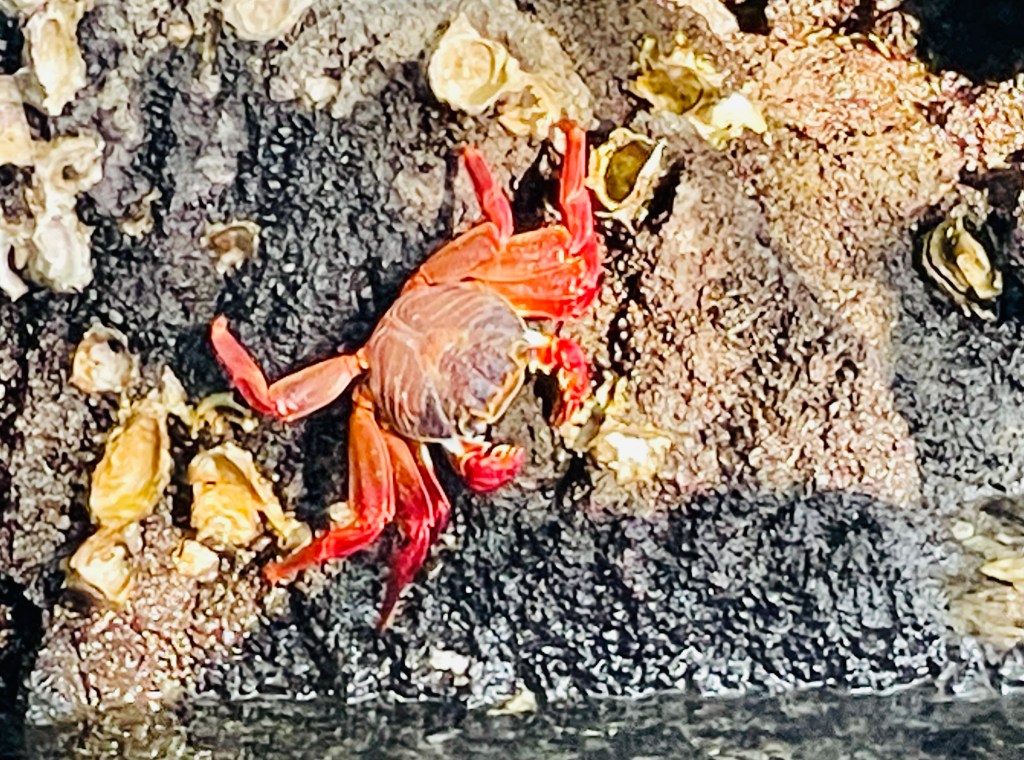
A Sally Lightfood crab is seen below. Even more interesting are the oyster shells on the lava. The Oyster Catcher birds are the ones who eat the oysters.
This young sea lion found a good sleeping place deep in the mangroves.
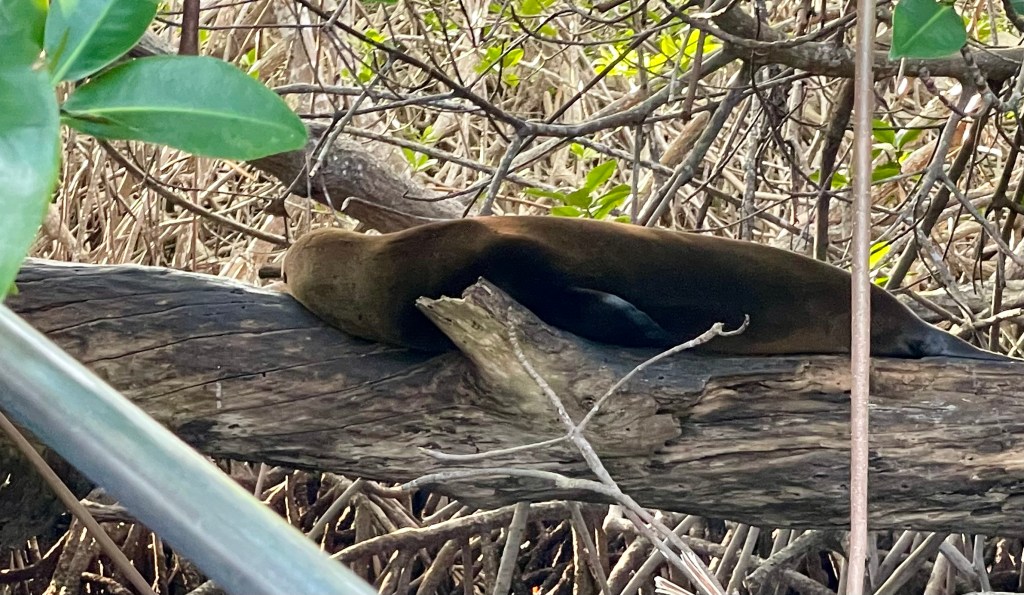
Until we came along.
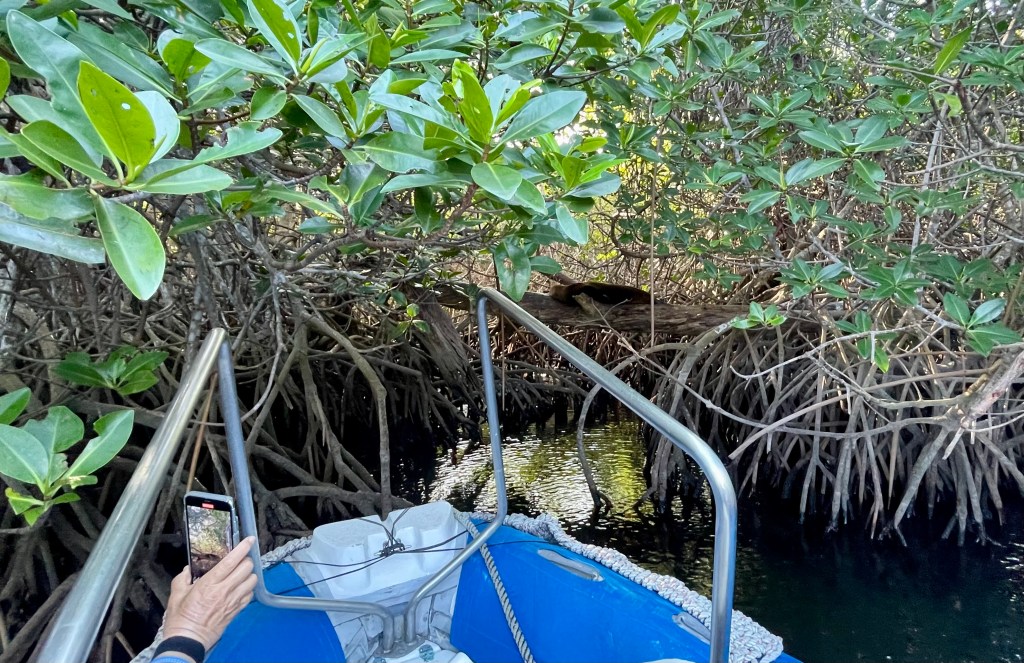
Red Mangroves are a key part of building life at the water’s edge. They are found all over the tropical world. Young and small creatures find safety among the dense roots. These are roots reaching down from near the tops of the trees to reach the water and to help anchor the plants.
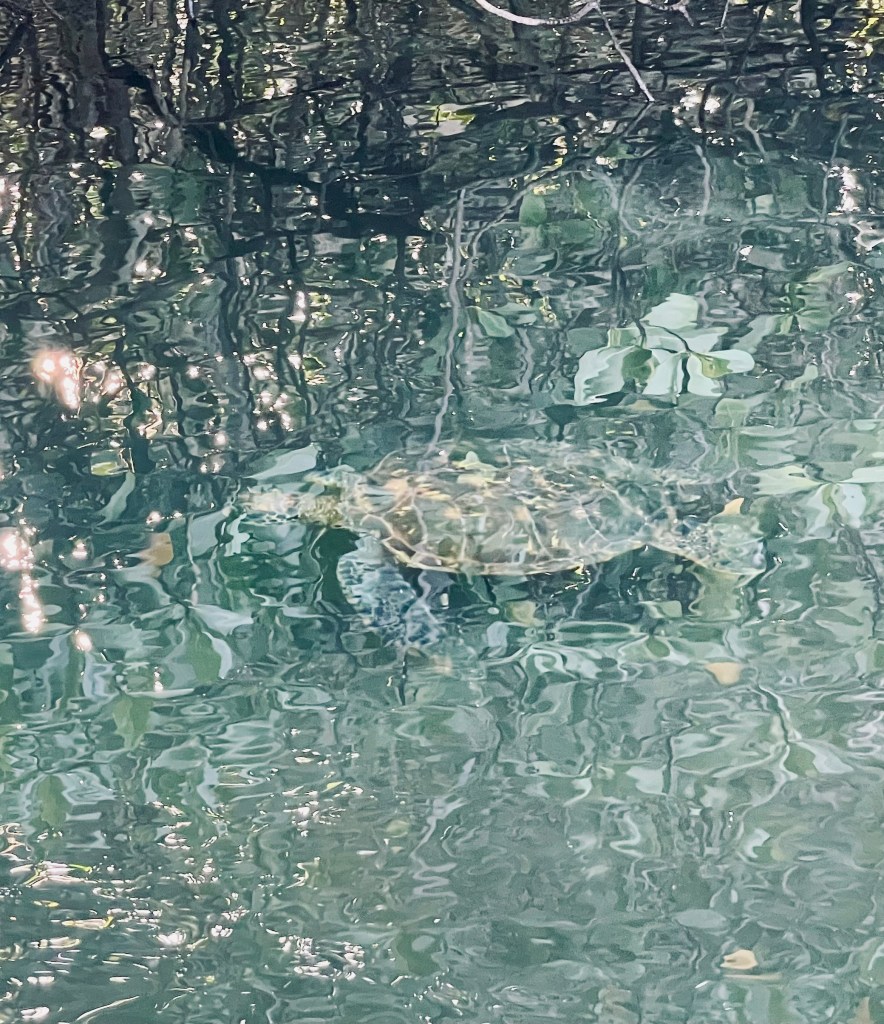
Even young green sea turtles seek the shelter of the mangroves.
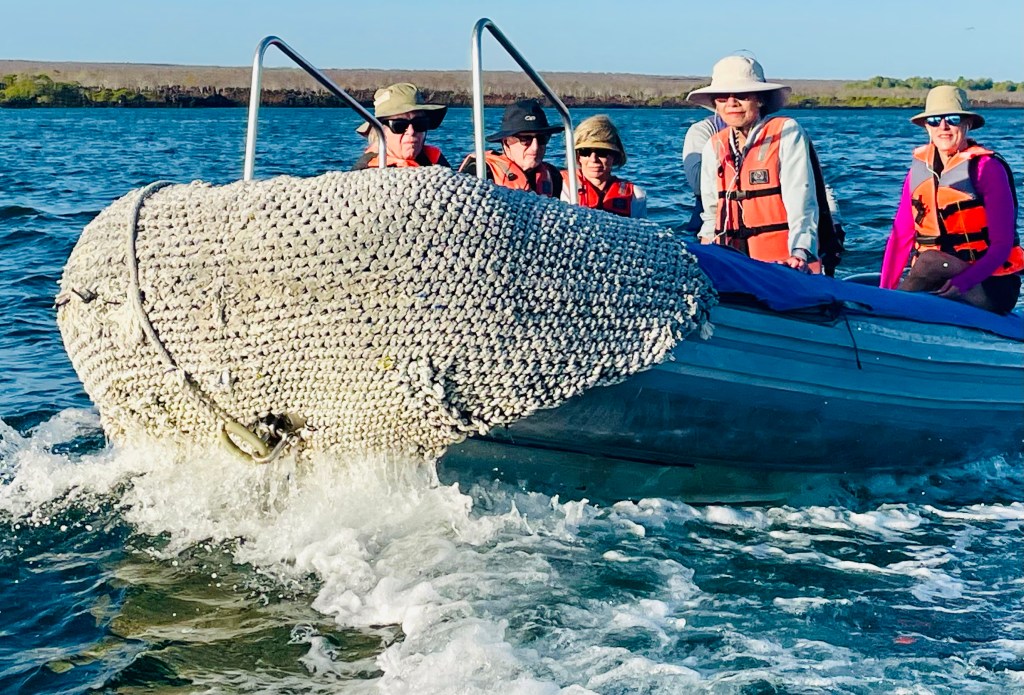
At one point we thought we spotted a pirate ship with the dreaded Barlas Gang leading the charge.
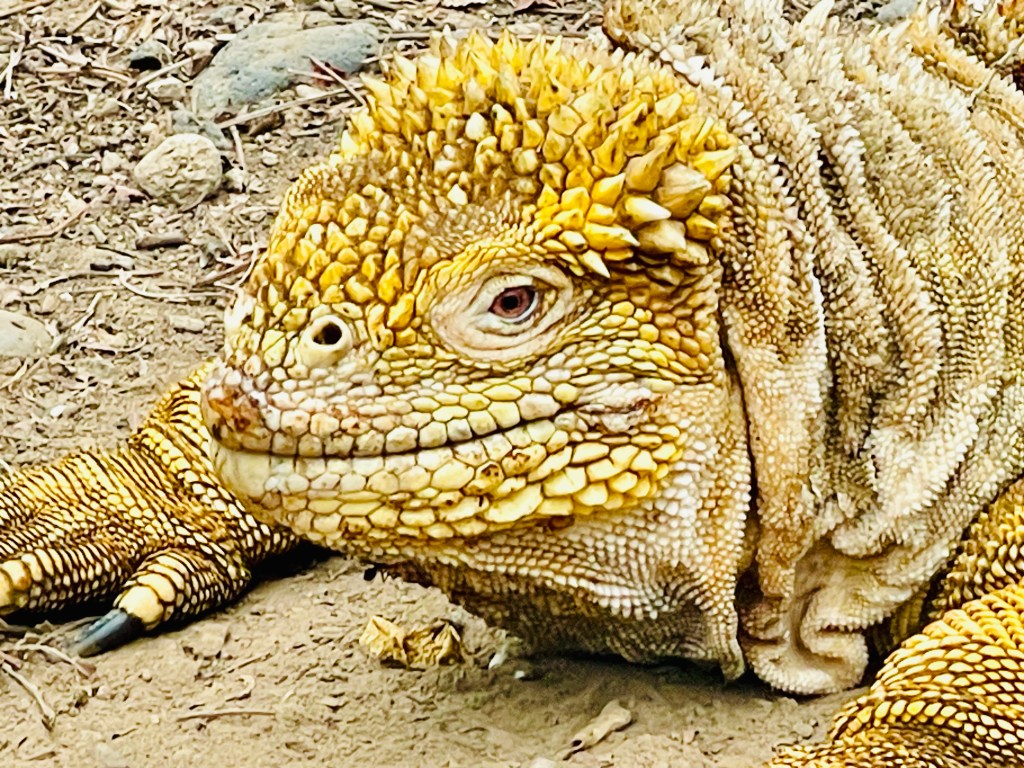
All the iguanas we spied so far were the marine iguanas. They dive into the sea to eat sea plants then rest for long periods in clusters in the sun to warm their bodies. The other iguanas are the terrestrial iguanas. They are bigger and more colorful. They burrow several feet under ground to sleep and hide. They lay in the sun to warm themselves as many reptiles do.

We had a talk this afternoon about plastics, particularly the plastic garbage that can pile up on the shores of some of the Galapogos Islands. With a population of only 35,000, this is obviously not their garbage, rather it is brought here by ocean currents that move the debris from around the world. They are extremely conscious about reduce waste, particularly plastic waste here on the islands and urge us to do the same when we return home.

 Observation Points 2
Leave a comment